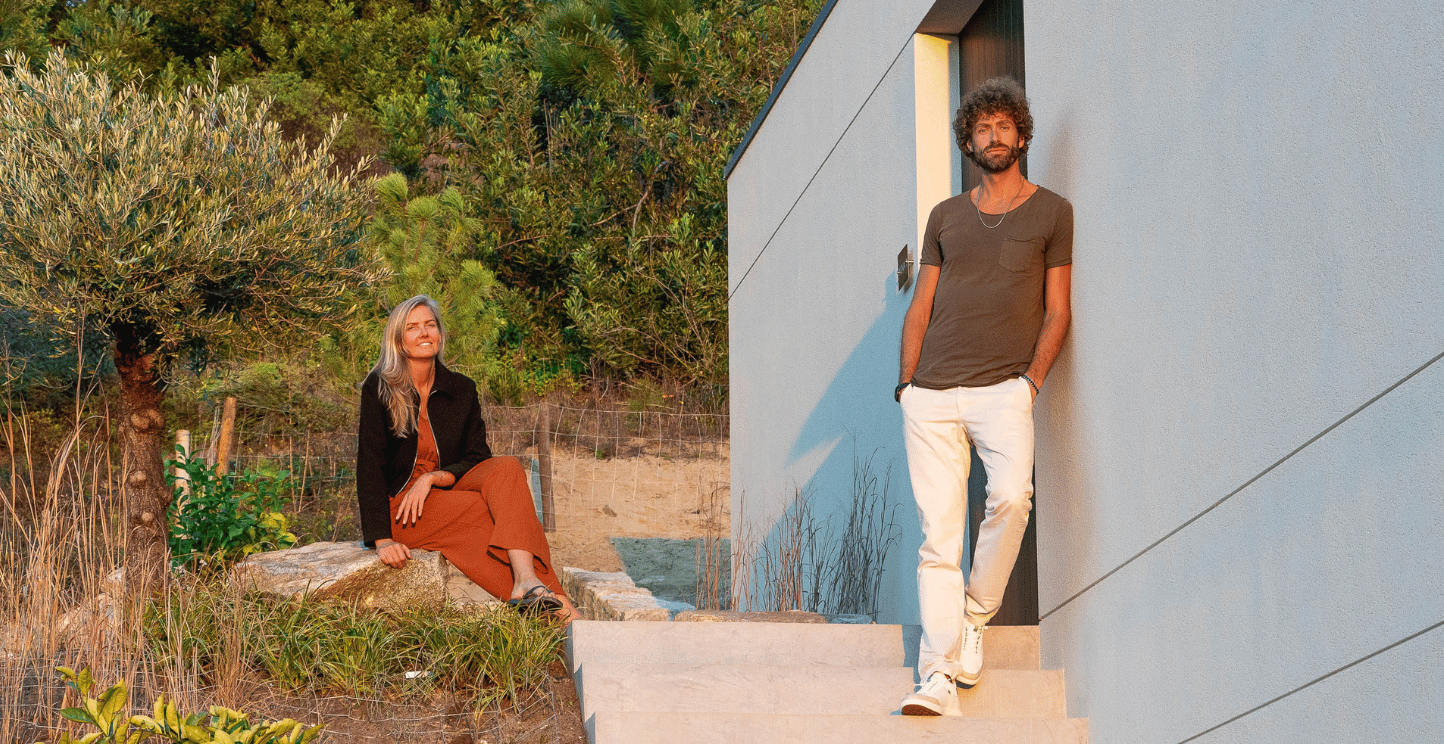
Yuna One and Yuna Two are finished, which still feels a bit unreal to write down. When we started, everything was just drawings, notes, and conversations that kept going in circles, about views, layouts, materials, and that feeling we wanted the houses to have. Now the homes are here, the place is alive, and we’re slowly moving from building mode into something that looks more like hosting, welcoming, and improving.
And you’d think this is the moment where you can finally relax. Where you sit back, look around, and say: we did it. But instead, we keep finding ourselves dreaming again.
Not because building in Portugal is easy (it really isn’t), and not because we’re already bored. It’s more that Yuna became more than a project. Somewhere along the way it started to feel like a new chapter—one we didn’t plan, but that keeps pulling us in deeper the longer we stay here. After our first full season, we can feel that shift even more.
Yuna is becoming a brand
The first season was exciting, but also a little nerve-wracking. We had poured so much energy into the details—how the spaces flow, how the light moves through the rooms, how everything feels when you open the doors and hear the ocean outside. Still, you never fully know what guests will notice, or what they’ll take home with them in their memories.
And then the reviews started coming in. People wrote about the calm, the comfort, the small details they didn’t expect. They mentioned things like the kitchen being properly equipped, the house feeling spotless and thoughtfully styled, the terrace and pool being the place where their days naturally ended. Some guests came back, others sent the listing to family or friends, and we started to notice something: the name Yuna was beginning to stick.
After one successful season, it’s becoming clear that Yuna is not “just” two houses anymore. It’s a brand in the making, and we can feel it starting to resonate. People begin to recognise it, talk about it, and connect it with a certain atmosphere. And what’s funny is that I can also feel myself shaping it more and more, not in a forced way, but simply through the choices we make: how we host, how we write, what we improve, what we keep quiet, and what we highlight.
So yes, we’re proud, and we’re genuinely grateful too, not only because the season went well, but because it feels like what we created here is starting to mean something to other people as well.
At the same time, there’s another feeling underneath it all: curiosity. Because once you’ve built something like this, and you see how it grows into something bigger than the original plan, a question keeps returning….
Could we do it again?
Right now, we’re looking again, both at land and at existing houses, and we’re doing it with much sharper eyes than the first time. The number one thing we look for is still the same as it was back then: the view. It can be a valley, mountains, or the sea. But it needs to feel wide and open, the kind of view that gives you space in your head, even on a busy day. We want to be surrounded by nature, but not in a way that turns life into a logistics puzzle. Quiet is wonderful, but not if it means you’re too isolated to enjoy the region, to grab a good coffee, or to reach shops and restaurants without turning every small thing into a long drive.
This balance is what we keep chasing. Nature, but not too remote. Calm, but still connected.
Don’t judge Portugal by July
People often underestimate how different Portugal can feel depending on the season. Many people view land and houses in summer, when the sky is bright, everything is green, the plants are blooming, and the landscape looks almost cinematic. In that light, it’s easy to fall in love quickly, and sometimes it’s easy to miss the practical reality underneath the beauty.
But winter is a completely different story. The ocean becomes rough, the wind has more force, rain can come sideways, humidity settles into places you didn’t expect, and water behaves very differently on hills and valleys. A spot that seems perfectly calm in July might suddenly feel damp, dark, or exposed in January. A small river can rise far more than you’d ever imagine, and a house built in the wrong place can end up dealing with moisture issues year after year.
It doesn’t mean winter is “bad”, some winter days here are honestly magical—but it does mean that buying or building with only the summer version of Portugal in mind is risky. If you want something that lasts, you have to build for the full year.
The “Ik Vertrek” mistakes (and why they keep happening)
In the Netherlands, there’s a TV show called ‘Ik Vertrek‘, where Dutch people move abroad and try to build a new life. It’s entertaining, but it’s also confronting, because you often see the same mistakes happen again and again, and Portugal is one of those countries where a small mistake can cost you months, or even years.
People buy land where they’re not allowed to build. Or they buy land that looks simple on paper, but turns out to be owned by a whole family, where not everyone agrees to sell. Sometimes there’s one owner you can’t reach, or one relative who simply doesn’t cooperate. And then there are the listings online: plots photographed with a camera from twenty years ago, wide-angle lenses, strange angles, beautiful words, and missing context. Houses that look charming in pictures, but in reality are in far worse condition than expected.
On top of that, there are the risks that don’t show up in a listing description. fire danger zones. flood zones and slopes that can move. Houses too close to rivers that overflow in winter. Homes built at the bottom of a hill where moisture becomes a daily battle.
Portugal is stunning, but it’s also raw and powerful, and if you want to build something that truly holds up over time, you have to respect nature more than your mood on a sunny viewing day.
The real estate reality in Portugal
Another thing that surprises a lot of people is how real estate works here. Portugal doesn’t really have the same culture of buyer’s agents the way some other countries do. Most agents work on commission from a sale, so their job is to sell. That doesn’t automatically mean bad intentions, but it does mean you’re not always going to get the honest conversation you wish you had about downsides, future problems, or whether something genuinely fits your situation.
Land is often even harder, because selling land can be slower and less profitable than selling a house, so it’s not always prioritised. And yet, land is exactly where the biggest mistakes can happen, because the legal and practical reality matters more than how it looks in a photo.
What helped us build Yuna (without knowing everything)
We didn’t build Yuna with perfect knowledge. Learn as you go, right? We asked a lot of questions, and sometimes we only understood things after we had already made a decision.
But we did make one important choice early on: we surrounded ourselves with people who did have the knowledge, and who were working for us, not for the seller.
We paid professionals to help us search, to check what was possible, to verify permits, to spot risks, and to negotiate when needed. Over time, we also built a team around us in Portugal that we truly trust—people who show up, do what they say, and care about quality.
Without that team, Yuna would never have happened. And now, thinking about a second project, we realise even more: the team is not the extra, it’s the foundation.
Writing this while the sea is roaring
I’m writing this while looking out at the Atlantic, and today the weather is intense, it’s announced to be code red. The rain is hitting the windows, the wind is relentless, and the ocean is wild. Waves up to 15 meters are the forecast, and you can actually see the white foam lines far out on the sea.
And yet, I feel calm. Not because the storm is small, but because I know we built in the right place. On solid stone. With a garage carved into the mountain itself. A home that doesn’t feel fragile, even when nature is loud.
Living here changes how you think. It teaches you to plan for the future, not only for summer. You start thinking about wildfires, water runoff, landslides, flooding, humidity, wind direction, sun angles, drainage, access roads—the full picture. And if you take all of that seriously, you realise: choosing the right location is not simple at all. But it’s worth it.
So what’s next?
We don’t know yet. But we do know we’re looking again, carefully. And we’re asking ourselves what the next Yuna could be, not just in terms of the view, but in terms of that feeling. Will guests once again, love the things we love about this region: the raw ocean, the hills, the quiet, the food, the people, the nature? Or are we biased because it’s our dream and our story?
That’s the question we try to figure out, while we explore new places. For now, we keep searching, we keep learning, and we keep listening to that same feeling that started it all in the first place:
The moment you stand somewhere, and you just know…
Are you looking for a home or land in Portugal too?
If you’re also looking for land or a house in Portugal, and you’re not sure where to start, feel free to send us a message. We’re happy to think along with you, share how our process worked, what we learned, and what we would do different next time.